Thursday, October 9, 2014

"The American Life": Evaluation & Application in ESL Listening& Speaking Classes

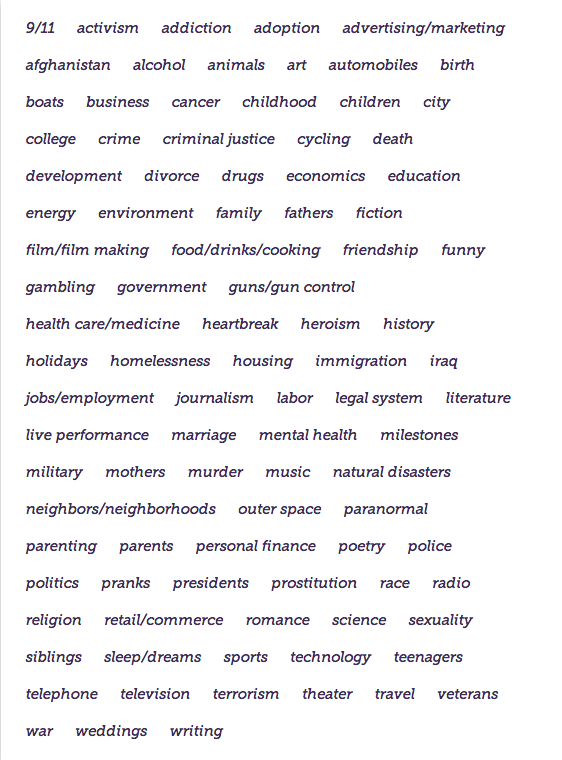
The American Life is one of the most popular public radio show in the United States, produced by Chicago Public Media. Thanks to Web 2.0 technology, now the entire show is freely available online via http://www.thisamericanlife.org/radio-archives. The theme of this show is on the life of everyday people from all walks of life, including a range of topics as listed below:

This entry provides an evaluation based on Hubbard's (2012) Methodological Framework on The American Life in regards to its adaptability in ESL listening & speaking classes. 

1. Technical preview: The show can be directly listened to or downloaded on different devices. According to the homepage of The American Life, the show can be listened to for free from the stream radio archive episodes. As an alternative, one can subscribe to the free weekly podcast and download the old episodes for $0.99 on iTunes or other podcasting tools on a computer or smartphone.  For ESL students who are practicing listening and speaking skills in the United States, it is convenient for them to access this show anywhere as long as they have internet connections.  Even if they don't have internet connections, they can still access the show in the old-fashioned way by listening to its radio station (click to see a list of radio stations in different state broadcasting this show) 

2. Operational description: The simplest way of accessing the show online is by directly going to its radio archives: http://www.thisamericanlife.org/radio-archives. One can simply click on one of the shows and listen to it. To select listening materials, students can be directed to the "ways to explore" box on the right side of the screen, which looks like this: 
Among the four sorting options listed here, students can choose one that interests them the most. For example, exploring "by tag" provides a list of topics covered in all weekly shows, as shown at the beginning of this blog. Students can then pick any topic that interests them and only listen to shows on that topic. One click on the topic "Business" results shows like the following: 
It is worthwhile to notice that the above selections of shows all have multiple tags, which means students are likely to encounter them again in searching under a different topic. 

If one is up to the idea of subscribe podcasts on mobile devices, The American Life also makes it easy for audience of all age groups, including senior citizens who are not familiar with technology. A video tutorial is provided in the following link on how to get a podcast: http://serialpodcast.org/how-to-listen

3. Teacher fit: From a teacher's point of view, this online show website is 100% authentic, which is designed by native speakers to deliver to native speakers. Because of this, language learning and pedagogical use are not taken into consideration from the content and design of the site. On the other hand, 100% authenticity does not necessarily mean that the show is hard to comprehend. Most shows, as a matter of fact, were recorded clearly in a normal speech rate.  Depending on the level of the students, teachers need to introduce this show with caution or do some selective listening in advance. 

4. Learner fit: The American Life would work the best as a supplementary listening material assigned to students as homework in an intermediate-advanced ESL listening & speaking class. It would work even better for courses taught within a content-based instruction curriculum, due to the wide range of themes it covers. One show typically lasts for around 50 minutes to an hour, which makes it a good choice as a weekly listening log assignment. 

5. Implementation schemes: Students first need to be directed to the website of the show and introduced to the different options they can use to listen to it. Depending on the theme of the class and the level of the students, teachers can either assign a topic for students to listen to or leave it open for them to explore by themselves. The students can be asked to do a short summary in either written (e.g., writing a blog entry) or spoken format (e.g., using Audioboo to record their summaries). Teachers can also ask one student to share his/her listening experiences in the first 5 minutes of class on a daily basis--this serves as an extrinsic motivation for students to complete the listening assignment. 

6. Appropriateness judgments: The American Life is a high-quality show that could benefit L2 students who are curious to know more about American culture from the points of view of civilians. However, students who are below the intermediate level English proficiency may find it too hard to understand this show, given the fact that minimum visual and textual support is provided. The most appropriate student group who can benefit the most from this show is intermediate-advanced ESL learners who are studying in a content-based curriculum or in learning about American culture. Different from news programs and other TV shows, The American Life helps to broaden the students' horizons in discovering and understanding the multifaceted details in everyday life of American people. 

Sunday, October 5, 2014

Using WebCorp to Learn American Slang Terms and Idioms

WebCorp is a new tool being developed by a research team at Birmingham City University. I first encountered this tool last year and have fallen in love with it since then. WebCorp stands for The Web as a Corpus, which shows the design of this corpus--all information is directly from web resources.

Web language nowadays is probably one of the most diverse and fast-growing language in the world. New coinages appear on a daily basis through different types of internet media and soon become widespread. To most effectively utilize a powerful tool like WebCorp, I have designed the following two types of activities for intermediate-advanced ESL learners.

1. Using WebCorp to learn new terms/slang language:
    Many of my students are interested to learn some commonly used academic slang terms. WebCorp could be an ideal tool to realize this in an effective way. For example, when you hear your American classmates say "pull an all nighter", what does it mean? The following is a screenshot of the concordance lines containing this useful colloquial expression from different English websites:


It is worthwhile noting that like other popular online corpora (e.g., COCA, MICASE), WebCorp also has the function of expanding the context to more words. Therefore, if we are curious to see a more complete context of this phrase while in use, we can click one of the concordances and more context will reveal.

2. Using WebCorp to learn American idioms:
Idioms are probably the hardest part in learning any language. On the other hand, they are also the most interesting and useful to learn if one is interested in knowing about the target language culture. I know some ESL classes have a special focus on learning American idioms, and the following activity may help to shed some lights on how to realize the understanding and use of idioms among international students.

Example activity: You've discussed the idiom "The A to Z of something" in your class; however, the students still have trouble using this idiom and would like to see more contextual usages. Let's use WebCorp to solve this problem! First, type in "The A to Z of" into the search box, and choose the language as "English". Click search and you should be able to see some concordance lines like the following:


Now, the default setting from WebCorp is for the search results to show under each URL, which may take a while for all results to show. Once all results are shown, one can then choose to see only the concordance lines without the URLs. I personally prefer the ones without URLs because they are easier to use in figuring out a pattern. The following is an example of another idiom "play... ace" without URLs.


Overall, WebCorp is a fun tool to play with for intermediate-advanced learners in learning new coinages and idioms. A major downside of this tool is that the search result may take a while to appear and one has to patiently wait till all results appear to choose other research options (e.g., not showing URLs). Despite this, I would still strongly recommend teachers to introduce WebCorp as a helpful resource to learners who are ready and eager to explore the language world of the internet.

Thursday, September 25, 2014

How to Fix A Collocation Problem Using COCA

The following is a video I have created using Screencast-O-Matic to address a common collocation mistake made by Saudi learners of English. Enjoy!


Wednesday, September 24, 2014

"I was wondering": What Does It Mean and How to Use it?

One idiomatic expression my students always had trouble with is the phrase "I was wondering". This is especially a puzzling point for my advanced ESL learners, who often hear this phrase in their daily life but keep "wondering" the exact meaning behind it.

To solve this puzzle, I looked up "I was wondering" in COCA, and the frequency counts showed 1729 total occurrences, with the majority (i.e., 1032 occurrences) in spoken situations.

The following is a snapshot of the concordances containing this phrase from some TV programs in the year 2012:


In a data-driven learning activity, it is important for learners to figure out the language use rules by examining the examples themselves. The following are some questions to help them get started:

1. What are the most common words/structures that follow "I was wondering"?
2. What's the tense requirement for the utterance containing "I was wondering"? Does it always need to be past tense?
3. When "I was wondering" is used together with present tense, what does it mean? Can you think of another phrase/word to express the same meaning?

After the initial discussion, the students will be shown the following clip from the TV show "Sex and City". They will be asked to interpret the meaning of "I was wondering" from the actor:


Upon the completion of the discussion, all students should be clear that "I was wondering if" is a polite way to make a request. Students are then encouraged to log in to the MICASE website and identify 5 specific examples of "I was wondering if" in making requests:
http://quod.lib.umich.edu/cgi/c/corpus/corpus?c=micase;page=simple

Students can also be encouraged to rewrite/change the examples they have located from MICASE and design dialogues or skits to practice this useful expression with a partner.


Thursday, September 11, 2014

Service Encounter: Checking in to a Hotel

The following activity is designed for intermediate-advanced ESL learners in a listening & speaking class. The goal of the lesson is to teach students how to check in to a hotel and how to complain when there are unsatisfactory services. The activity has four parts:

1) Pre-listening questions: These questions serve as a warm-up discussion basis for the class and help to activate the preexisting schemata.

2) Comprehension questions: These questions serve as a language and culture guide to students while they are practicing listening skills via watching the movie clips found in Youtube. Students need to listen for not only main ideas and details but also cultural notes.

3) Post-listening questions: In the stage right before the production task, it is important for students to understand what they should do and how they can do it while checking in to a hotel. These questions help the class to summarize what they have learned through watching the movie clips.

4) Recorded role-plays: This is the final stage, which contains a production task. Students are asked to work in pairs and record a role-play in Audioboo as a class assignment.

Checking in to a Hotel: Pre-listening Questions

1. Have you ever checked in to a hotel before? What is the procedure you need to go through in checking in?

2. What types of rooms do the hotel usually have available? Which types are more expensive? Which type of room do you usually reserve?

3. What services do the hotel usually provide? What do you need to prepare if you were to stay in a hotel?

4. What should you say when you are checking in to a hotel you have reserved?


Checking in to a Hotel: Comprehension Questions


Instruction: Watch the first four movie clips about hotel check-in in the video (0:00 - 8:06). You will watch each clip three times to answer the following list of questions.


1. The Hangover (2009)

1) Which one of the guys made the reservation? What is his name? What does he do for a living?


2) What type of room did the guys have? On which floor?


3) Why did one guy who wanted the villa say that he was not willing to share beds with the others?


4) Why didn’t the doctor want to use his credit card?


5) What did the hotel ask for a credit card during check-in?


6) What is the name of the hotel?


2. The Graduate (1967)

1) Why did the receptionist ask the guy if there’s anything wrong with him?


2) Why didn’t the guy want the porter to bring in his luggage?


3) Did the guy follow the porter to his room?


3. Friends

1) Who made the reservation? Where does he come from?


2) Why did the guy who made the reservation feel frustrated?


3) What type of room did they end up having? What’s the rate for it?


4) What did the other guy suggest they do instead of paying for the hotel?


5) What did the guy mean when he said “they are totally ripping us off”?


6) What did the other guy suggest to make their money back from the hotel?


7) What’s the room number of the two guys?


8) What were the complimentary toiletries that the guy asked on the phone? Why did people laugh?


9) Do you agree with what the guy said on the differences between “stealing” and “taking what the hotel owes you”?


4. Seinfield

1. What kind of car did the guy reserve?


2. According to the guy, what’s the difference between “taking the reservation” and “holding the reservation”? Which one is more important?


Checking in to a Hotel: Post-listening Questions

1. Based on the movie clips, what should you say first to check in to a hotel room you have reserved?  


2. If the receptionist has not been able to hold your reservation, what should you say?


Recorded Role-Play on Audioboo

Instruction: Together with one classmate, design a short role-play about checking in to a hotel. One of you should play the role of the receptionist, and the other should be in the role of the customer. Include a scene of unsatisfied service (like what you have seen in the clips of Friends and Seinfield) and demonstrate how you resolve the problem. Your role play will be graded using the following rubric:

Greetings
The receptionist initiates the conversation with an appropriate greeting.

1
0
Information
The customer provides necessary information in correct sentence structures.  

1
0
Problem
The receptionist describes a problem with the reservation in an appropriate manner.
2
1
0
Complaint
The customer voices a complaint in an appropriate manner.
2
1
0
Solution
Both parties work out a solution in appropriate languages.
2
1
0
Pronunciation
Comprehensible pronunciation of single words/phrases with appropriate volume, intonation, and pauses.
2
1
0
Total
        /10


Answer key to comprehension questions:

1. The Hangover (2009)
1) Doctor Price made the reservation. He is a dentist.
2) a two-bedroom suit on the 12th floor
3) In the U.S., it is considered strange for adult guys who are straight to share beds with each other.
4) His wife, Melissa checks his bank statement, and he doesn’t want her to find out about the hotel reservation.
5) The hotel needs a credit card to be on hold in order to keep a file of the guests.
6) Caesar’s Palace
2. The Graduates (1967)
1) He looked sad and lonely, and he asked for a single room.
2) He didn’t want to have all the trouble to bring the luggage in, and he just needed a toothbrush.
3) No.
3. Friends
1) Chandler Bing, from New York City.
2) They tried to cancel the reservation the day before but was told it’s non-refundable, so they drove six hours to get to the hotel, but the hotel did not have their reservation.
3) Deluxe Suit, $600 per night
4) He wanted them to drive back to New York and stop at every maple candy store.
5) The only room left for them was too expensive, and he felt being cheated.
6) He suggested that they took lots of the hotel’s amenities.
7) Suite 206
8) Toothbrush, toothpaste, razor, mouthwash, deodorant, dental floss, bandage, shaving cream, after shave, and tampons. It’s funny because he is a guy and he doesn’t need tampons.
9) No, he thought as long as it is complementary, he can take whatever he wants in large amount. But in reality, this is taking advantage of the hotel’s complementary policy, which should mean take only if you need it.
4. Seinfield
1) Midsize
2) The hotel only knows how to take the reservation, which means they accept whichever request the customer made. They don’t know how to hold the reservation, which means to reserve only the type of service the customer requested. Holding the reservation is more important. 

Wednesday, September 10, 2014

Audioboo Exercise

Click the Audioboo icon on the lower right corner. This will direct you to a listening & speaking activity that I have designed in Audioboo. Listen to the recording first, and then provide your answer via "Record a comment". You have to first log in to Audioboo and have your microphone enabled in order to record a comment.

Thursday, September 4, 2014

A Lesson Plan for Advanced Learners Using Google Hangouts

Since this week's topic is on Synchronous Computer-Mediated Communication, I decided to further explore my latest favorite SCMC app, Google Hangouts. In my last blog entry, my evaluation concluded that Google Hangouts is more suitable for advanced learners. Therefore, I have designed a lesson specifically for this group. Since this lesson has not been implemented yet, I welcome any suggestions and criticisms. I hope to try it out in the near future!

A Lesson Plan on Career Analysis Using Google Hangouts

Targeted learners: advanced/highly-advanced ESL learners, preferably students who are conditionally admitted to graduate school.

Lesson background: The students are working on a group project called “Career Analysis”. They are required to interview a senior student/expert in their chosen career and use the information from the interview to write a paper analyzing the different aspects of the career. This could be a collaborative project in an advanced research writing class that offers in many ESL programs. Ideal class size should not exceed 15 students. This particular lesson only covers the interview part of the project.

1. Goal:
Students will comprehend and perform formal conversations.

2. Objectives:
Terminal objectives:
1) Students will request information on a topic that they are not familiar with.
2) Students will comment on information provided by others and engage in a formal conversation.
Enabling objectives:
1) Students will comprehend a formal interview conversation between the instructor and an invited speaker.
2) In the interview, students will identify the key questions asked by the instructor and how to initiate new topics.
3) Students will comprehend necessary words, phrases, and expressions in the interview conversation.
4) Students will brainstorm interview questions together and discuss interview plans on Google Video Hangouts. (A detailed instructional manual on how to use video call via Google can be found via this link )
5) Students will conduct an interview with a senior student/expert in their chosen career and broadcast their interview on Youtube via Hangouts on Air.
(A detailed instructional manual on how to do live broadcast using Hangouts on Air can be found via this link)

3. Materials and equipment
• Projecting equipment with amplifiers
• A computer connected to the internet and projector
• Computers for students to use (with microphone & camera embedded)

4. Procedures
1) Warm-up: As a whole class, brainstorm future career paths that the students want to pursue. List all career choices on the board.
2) Demo video watching: Introduce the demo video, a formal interview between the instructor and an invited speaker. Tell the students the background and purpose of this video. Watch the video once and then during the second showing, ask students to take notes of the key questions asked in the interview. Hand out a transcript of the interview, and ask students to underline words/phrases the instructor said to shift topics.
3) Technology training: Ask students to sit by their computers and create a Google account if they don’t have one: https://accounts.google.com/signup?service=mail

Once this is done, ask students to share their Google address with the instructor on the same Word document, which is then projected on the big screen. Afterwards, students should be directly to follow the instructions on the following webpage to get prepared for making a video call: https://support.google.com/hangouts/answer/3110347?hl=en

Finally, students should be introduced to the features of Hangouts on Air, a broadcasting tool to publish their video interviews. The following is a detailed instructional manual: https://support.google.com/plus/answer/2553119?hl=en&ref_topic=2553242&rd=1

The following is a video tutorial of how to broadcast google hangouts:


4) Video hangout trial: Students add two other class members and their instructor to their circle of video hangouts and practice making a video call and doing a live broadcasting.

5. A follow-up class activity:
Students, in small groups, reserve a time slot with the instructor and do a practice session using Google Hangouts and Hangouts on Air. During this session, students should discuss their interview plans with the instructor.

6. Assignment:
Students, in small groups, make appointment with a senior student/expert in their designated career to do a video interview. All group members will participate equally in the video interview, record, edit and publish the interview session on Youtube channel and share it with the whole class.